There is something paradoxical about coworking. People sometimes come here to escape the isolation of remote working, sometimes to escape the hustle and bustle of a traditional office — and often for both reasons at once. Because the real challenge of working in a shared space is not choosing between concentration and interaction, but knowing how to make them coexist.
The good news is that it’s entirely possible. All it takes is a few well-established habits and a well-designed environment.
Understanding your own work rhythms
Before even talking about organisation, there is a fundamental question to ask yourself: when are you really available to think?
Some people are at their most focused early in the morning, while others peak in the early afternoon. Identifying these time slots is the first step in structuring your coworking day in a smart way.
In concrete terms, it might look like this:
- Morning: tasks that require the most depth — writing, analysis, development, strategy.
- Midday: informal exchanges, collaborations, calls.
- Afternoon: processing emails, short meetings, more mechanical tasks.
This division is not set in stone, but it provides a framework. In coworking, it is essential to set this framework yourself, as there is no hierarchy to do it for you.
Create rituals for concentration
Concentration cannot be improvised. It sets in gradually when the brain receives clear signals that it is ‘time to work’. This is what psychologists call anchoring routines.
In a coworking space, these rituals can take different forms:
Headphones are one of the most universal signals. Wearing headphones even without music sends a non-verbal message to those around you: I am in concentration mode. Most coworkers instinctively respect this code.
The rule of time blocks is another effective technique. Work in 45- to 90-minute sessions without interruption, then allow yourself 10 to 15 minutes of free interaction. This alternation structures the day and preserves mental energy.
Choosing where to sit also plays an underestimated role. Systematically sitting in the same corner, away from passageways or relaxation areas, helps the brain associate that place with cognitive effort.
Enjoy conversations without getting lost in them
Coworking is also, and perhaps above all, a human resource. Spontaneous conversations with other self-employed people, freelancers or small teams often lead to unexpected ideas, fruitful collaborations and even new clients.
However, it is important to give them the space they deserve, without letting them take over the whole day.
Set aside time for exchanges
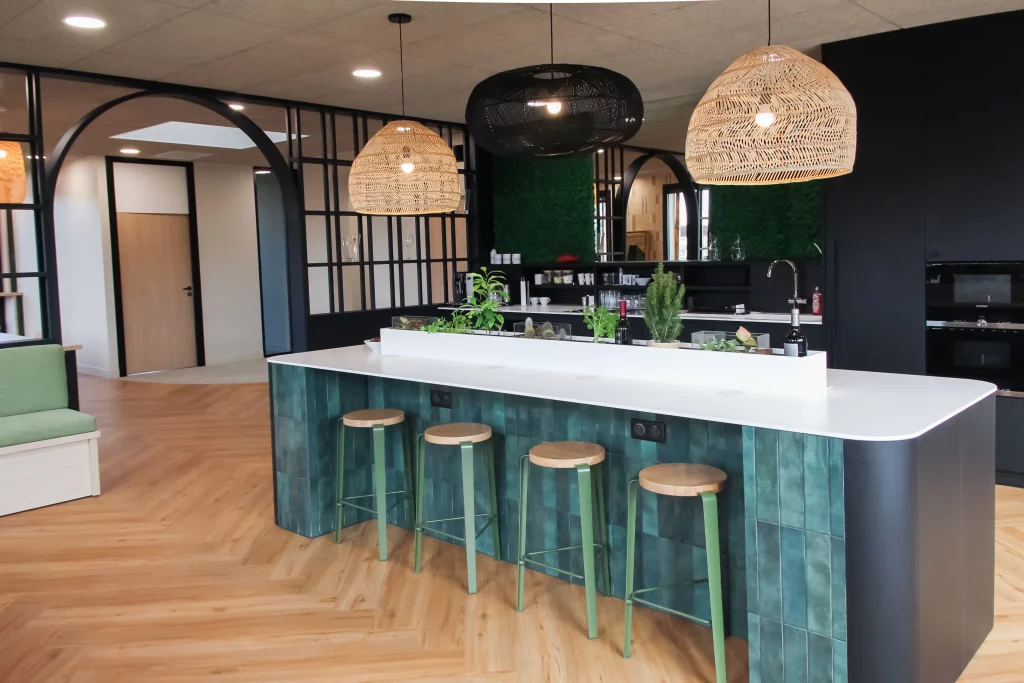
It’s no coincidence that the coffee machine is often the beating heart of a coworking space: it represents a break, a moment of relaxation where conversation is welcome. Make a conscious effort to take advantage of this, rather than letting exchanges creep into the middle of an intense work session.
Be clear about your availability
A simple ‘I’m working on an important project until 11 a.m., I’ll get back to you after that’ is enough in 99% of cases. Coworkers, who face the same challenges themselves, understand.
Participate in group activities offered by your space
Some spaces organise lunches, after-work events or networking sessions. These moments are designed to help you forge connections, so make the most of them rather than trying to socialise on the fly in the middle of the day.
The environment: a decisive factor
However, all these personal strategies have their limits if the space itself is not designed to accommodate different ways of working.
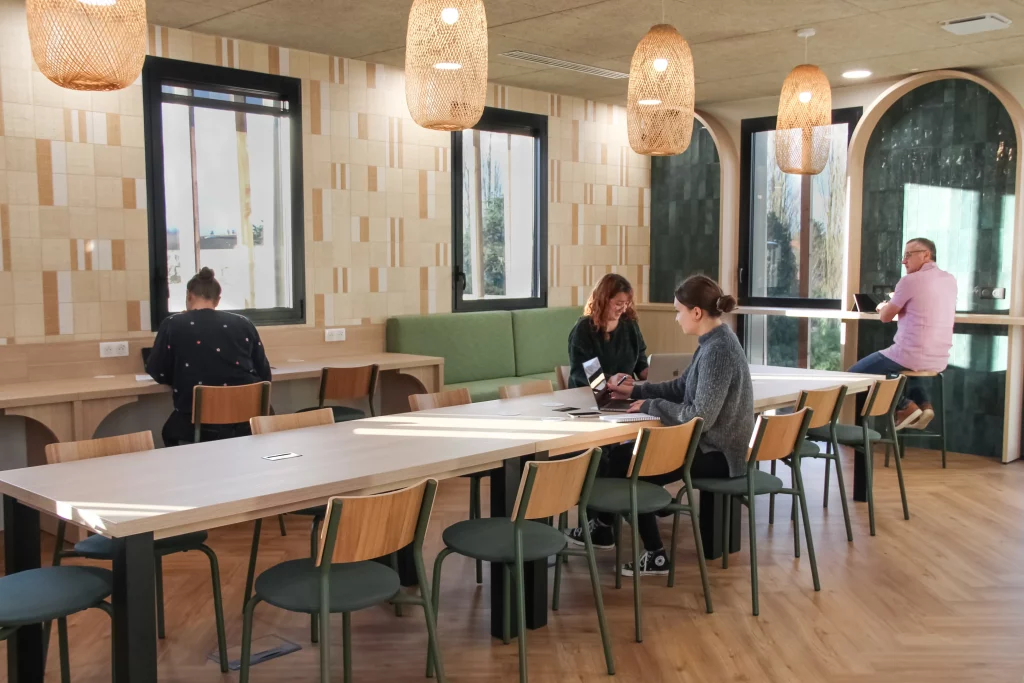
A good coworking space should offer separate areas: open, dynamic spaces to encourage interaction, but also quiet areas or closed bubbles for periods of intensive work. Acoustic separation, quality lighting and the availability of meeting rooms on demand all play a huge role in the daily life of a coworker.
It is precisely this focus on usage that guides the ESPACE TRIANGLE, located in Bayeux, Normandy. Designed to meet the real needs of independent professionals and small teams in the region, the space offers environments adapted to different times of the working day: open workstations for working in a collective dynamic, and more secluded spaces for moments that require your full attention. It’s a place worth knowing about, in a town that is often underestimated for its local economy and quality of life.
In summary: finding your own balance
There is no universal formula. Some people will need several weeks to find their rhythm in coworking, while others will settle in naturally from the very first days.
What is certain is that concentration and interaction are not enemies. They are two sides of the same coin: fulfilling work, rooted in a community, but respectful of your cognitive needs.
When done right, coworking offers exactly that: the freedom to choose how you work, in an environment that makes that choice possible.